
Does homeowners insurance cover a burst pipe or an appliance leak?
Usually yes, when the failure was sudden and accidental. Slow leaks you could have found are usually excluded. What decides your claim is documentation, so photograph everything before anything is moved or dried, and report it the same day.
Watch: document it before anything is thrown away
Sudden and accidental, or slow and ignored
Almost every standard homeowners policy in Michigan, Ohio and Florida draws the same line. A supply line that let go this morning, a hose that split behind the washing machine, a toilet that overflowed: sudden and accidental, and generally covered. A fitting that has been weeping under the sink for eight months and has rotted the cabinet floor: generally not, because the policy expects you to have found it.
Two things sit on either side of that line and catch people out. The cost of repairing the failed part itself is often not covered, even when the damage it caused is. And the sewer backup that comes up through a floor drain is usually a separate endorsement rather than part of the base policy.
Your own policy is what decides, not this page. Read the water damage section, or ask your agent to read it to you. We are a restoration company, not your insurer or your adviser.
What to document before the adjuster arrives
This is the part that is entirely in your control, and it is the part that most often decides how a claim lands. Do it before anything is moved, dried or thrown away.
- Photograph each affected room wide, from the doorway, before you touch anything.
- Photograph the failed part close up: the split hose, the cracked fitting, the overflowing fixture. Keep the part itself if it comes out.
- Photograph the water line on the walls and on the baseboards. That line is the evidence of how high and how far the water went.
- Video a slow walk through the affected rooms, narrating what happened and when you found it.
- Write down the time you discovered it and the time you shut the water off. Claims turn on timing more than on anything else.
- Keep every receipt from the moment it happened, including the plumber, the fans you bought and the hotel if you had to leave.
- Do not throw anything away before the adjuster or your restoration contractor has recorded it, even if it is obviously ruined.
A real job, documented
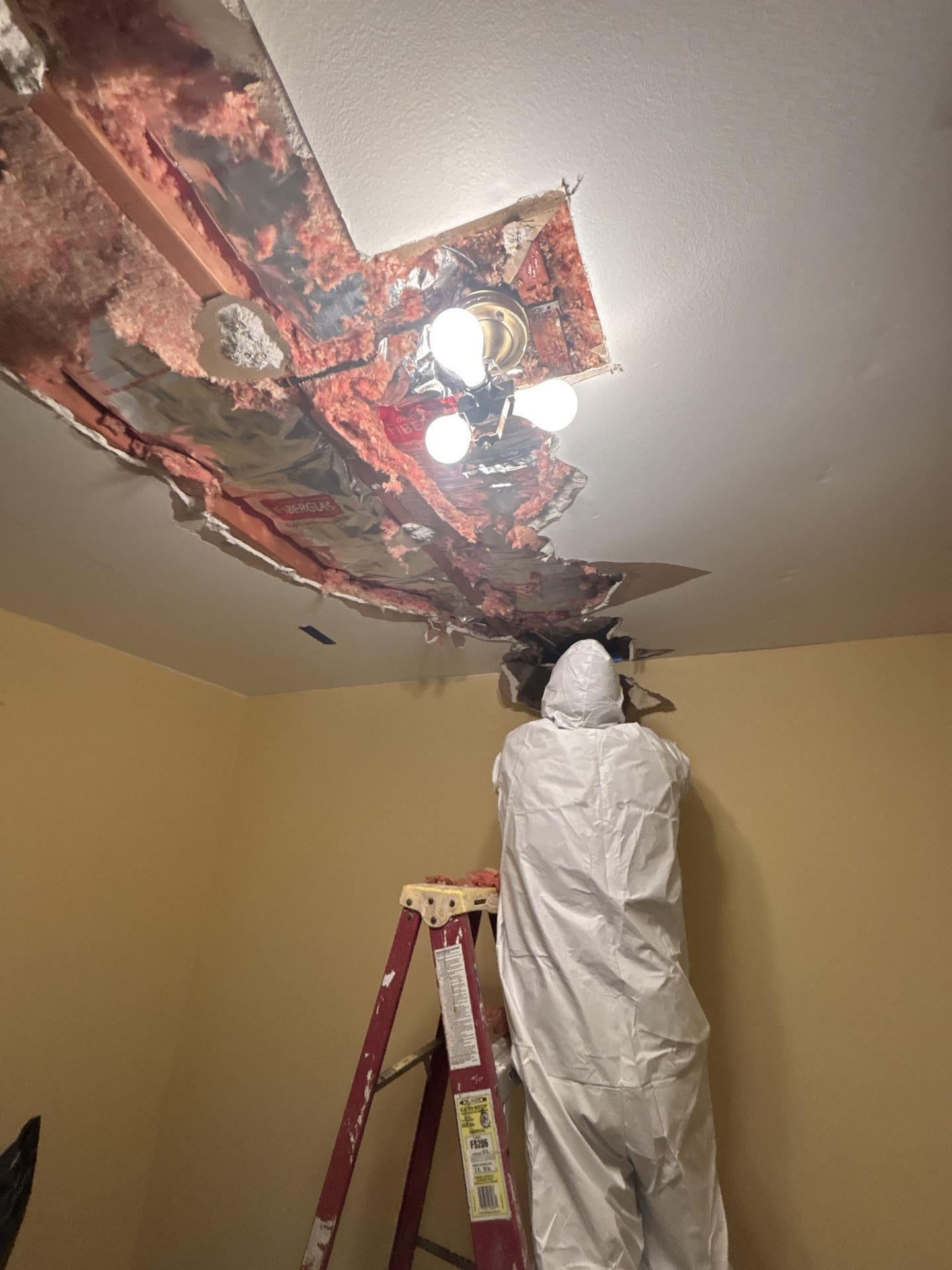
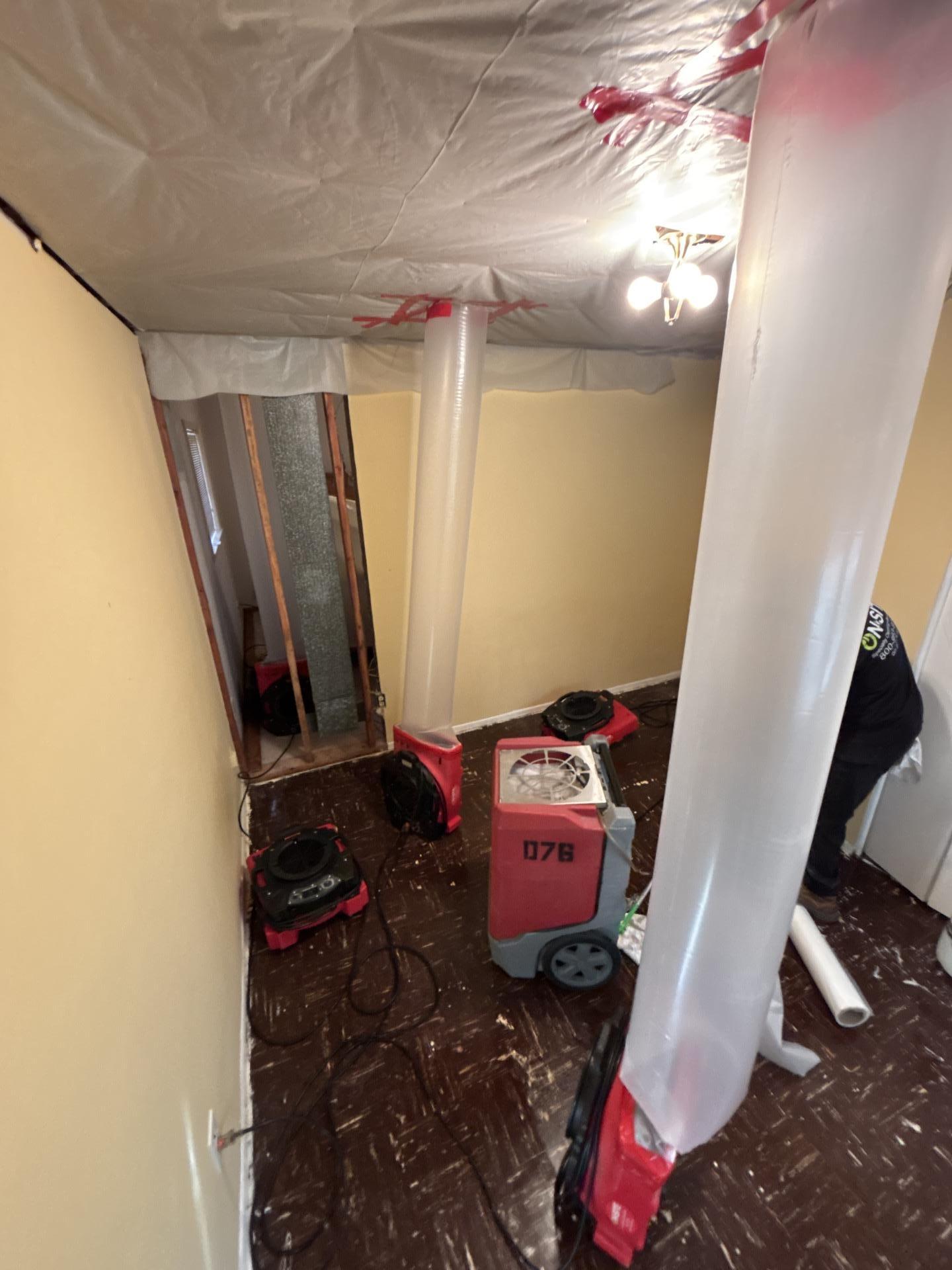
A recent job of ours in Dearborn Heights: a tree came down in a storm and rain got into a bedroom ceiling.
When does the insurer pay?
Not before the drying is done. The insurer does not cut a check to the homeowner until the drying has been fully completed. A check for the repairs and for your contents may follow after that.
The order a claim usually runs in
Timings vary by carrier and by how busy the region is, but the sequence rarely changes.
- You report the loss to your carrier and get a claim number.
- Emergency mitigation starts immediately. It does not wait for the adjuster, and policies generally expect you to prevent further damage.
- An adjuster inspects, or a desk adjuster reviews your photographs.
- Drying is completed and documented. The insurer does not cut a check to the homeowner before this point.
- Scope and estimate are agreed between the adjuster and your contractor.
- Repairs proceed, often with an initial payment and the remainder on completion.
- Anything found later, behind a wall or under a floor, is raised as a supplement.
Frequently asked questions
Should I call my insurer or a restoration company first?
Call a restoration company first.
Will making a claim put my premium up?
That is a carrier decision and it varies, which is why many people ask before they report. What we can tell you is the practical trade: the cost of drying a room properly is usually a fraction of the cost of replacing a subfloor and wall cavity six months later.
The adjuster says the damage is less than what my contractor estimated. What now?
This is common and usually a scope disagreement rather than a dispute about honesty. Moisture readings, thermal images and a drying log are what resolve it, because they show what was wet rather than what looked wet. Ask your contractor for the documentation and have the adjuster review it.
Does insurance pay to fix the pipe that burst?
Often not. Many policies cover the damage the water caused but exclude the cost of repairing the failed component itself, unless it is a frozen pipe: those are covered. The plumbing bill and the restoration bill are usually treated as two different things.
Is a sewer backup covered?
Usually only if you carry the specific endorsement for it. Water coming up through a floor drain is treated differently from water coming out of a supply line, and it is also a contaminated category, which changes how the cleanup has to be done.
Can I choose my own restoration company?
Yes. Carriers keep preferred vendor lists and may suggest one, but in Michigan, Ohio and Florida the choice of contractor is the property owner’s.
Who we are
On-Site Specialty Cleaning + Restoration. Certified technicians, 24/7, serving Metro Detroit and southeast Michigan and the Tampa Bay region, with contents cleaning and storage in the Toledo region of northwest Ohio. Always On to help get your life back to normal.
Call (800) 993-9345. We answer 24 hours a day, every day.
Related guides
- Water is coming in right now. What do I do first?
- What happens to my belongings after a house fire?
- Water, fire and mold: the questions Michigan homeowners actually ask
Full transcript
Read the transcript of the film
After a fire or a flood, it’s tempting to start throwing things away. Don’t. Not yet. First, document everything before you move it. Photos and a written inventory protect your insurance claim. A professional pack-out changes everything. Certified crews inventory, pack and move your belongings to a climate-controlled facility, clean and restore them off site, then bring them back when your home is ready. Things that matter most are worth saving. When it matters most, we’re always on. Call On-Site Specialty Cleaning and Restoration.